Thursday, December 7, 2023

Scarf Three of Three

 Picture of knitting the scarf

Photo by Dr. Haus

Knitting

Well, this scarf is probably my least favorite - the idea in was great in the hypothesis form but the final product is not my favorite.  I wanted to create a diagonal pattern on the scarf while holding the orange and blue pieces of yarn together.

🧶

Finishing this last scarf was a bit of a challenge as I wasn't very excited about the scarf.  I had forgotten that when you use multiple yarn colors at the same time it does mute the colors.  This was disappointing to me because bright orange is my favorite color and in this scarf the orange is much duller than I would have liked.  I also think my diagonal pattern did not exactly work.

The third scarf: 


Picture of the Scarf

Photo by Dr. Haus

Overall, this is a post to finish the scarf knitting blog posts and took me awhile to write up because I do not like this specific scarf.  Either way, as always, this is a great reminder that each project is a learning experience and will help you continue growing.

🧵 

Dr. Haus's Unsolicited Life Advice:  Knowing what you don't like is as important as what you do like

Thursday, November 30, 2023

Scarf Two Out of Three

 \\Picture of partially created scarf with Melvin

Photo by Dr. Haus

Knitting

While I was visiting my family for the holidays, I finished the second nephew scarf.  For this scarf, I wanted to try a new knitting method where I could knit the scarf vertically with two different colors.  For this scarf, I decided to use a 5x5 ribbing pattern with 15 stitches of each row done in orange and the next 15 stitches done in blue.

🧶

I learned two important lessons with this scarf.  Firstly, it took me about 10 rows to correctly understand how to switch between the two different colors without needing to cut the yarn and start with a new strand.  The secret was to make sure the new color was moved to the left of and on top of the old color.  A friend mentioned another great option would be to knit the two colors together for one stitch and then switch to the new color.

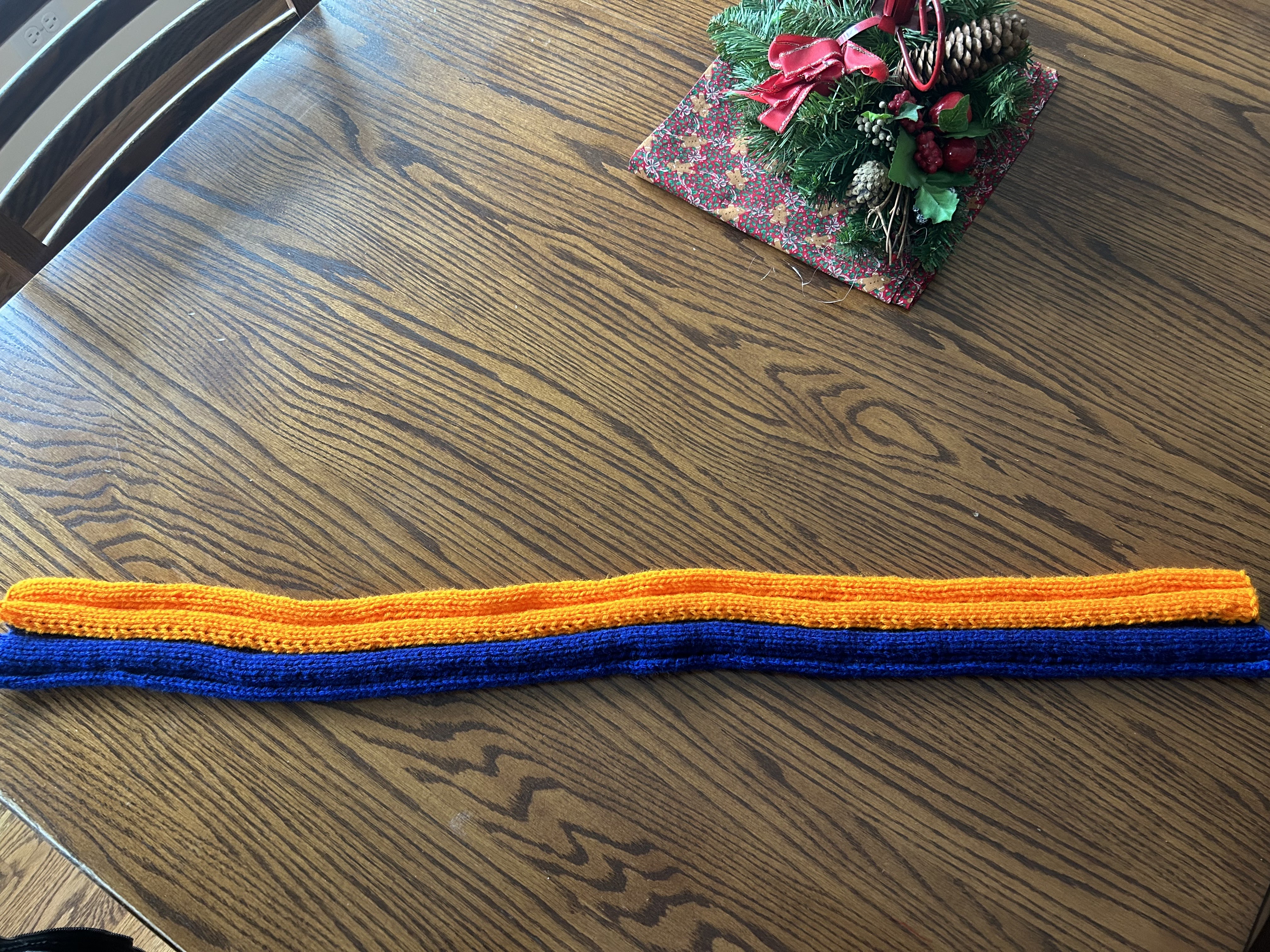
The second scarf: 


Picture of the completed scarf

Photo by Dr. Haus

The second thing I learned through this project was that a 5x5 ribbing pattern made the width of the scarf very small as you can see above.  This pattern causes the stitches to shrink together.  I was slightly able to increase the width of the scarf through the blocking process but it still keeps shrinking in the horizontal plane.  Moving forward, I will not be using the 5x5 ribbing pattern but I am glad I tried this process as the best way for me to learn something is to commit to the plan, complete the plan, and learn what I liked and didn't like about the project.


Folded scarf picture
Photo by Dr. Haus


Step 1:  Cast on 30 stitches with the following pattern - Cast on 5 stitches knitwise then 5 stitches purlwise then 5 stitches knitwise SWITCH COLOR Cast on 5 stitches purlwise then 5 stitches knitwise then 5 stitches purlwise

Step 2:  Knit 5, Purl 5, Knit 5, SWITCH COLOR, Purl 5 Knit 5 Purl 5

Step 3:  Repeat step 2 until the scarf is the length you want

Step 4:  Bind off using the following pattern - Bind off 5 stitches knitwise then 5 stitches purlwise then 5 stitches knitwise SWITCH COLOR (keep playing video to the end) Bind off 5 stitches purlwise then 5 stitches knitwise then 5 stitches purlwise

Step 6:  Weave in ends

🧵 

Dr. Haus's Unsolicited Life Advice:  Learning from an imperfect project is progress

Saturday, November 25, 2023

Conclusion Caturday: Sick Swinehaus Swine (Case 5)

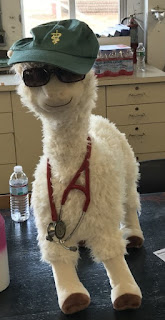
Picture of stuffed alpaca Professor Pocky and stuffed camel Douglas

Photo of TA Douglas (Left) and Professor Pocky (Right) taken by Dr. Haus
 

Click For Explanation of Case Flow


Click for Test Case Tuesday:  Sick Swinehaus Swine


Click for Thoughtful Thursday:  Sick Swinehaus Swine 


Quick Review


Diagnosis:

🐽African Swine Fever🐽


Pathophysiological Point:

African Swine Fever (ASF) is an extremely fatal viral disease of domestic swine.  The ASF virus mostly infects the macrophages/monocytes of the pigs.  This causes a huge depletion in the immune cells of the animals.  The presentation of ASF is similar to Ebola in humans where the pigs have high fevers and start bleeding from different orifices.


 Questions, Answers, and Further Information:


Level 1 Questions, Answers, and Further Information:

  1. Explain why the veterinarian contacted the state veterinarian to report the disease outbreak.  (HINT:  Think about the severity of the pigs sickness and the information given at the start of this post).  

    The veterinarian contacted the state veterinarian to report a suspected foreign animal disease case.  When a large amount of animals die showing concerning signs the state veterinarian needs to be notified to ensure samples are taken to quickly diagnose the disease.  If the disease is a threat to other animals and the country we need to diagnose it quickly to contain the outbreak.


  2. Explain why the pigs are dying so quickly.  (HINT:  Think about the physical exam findings and the major finding that was found in the dead pigs' autopsies/necropsies)

    The pigs are dying quickly because they are bleeding from their noses, mouths, and other orifices.  When too much blood is lost, there is not enough oxygen getting to the cells of the body and the pig cannot survive without oxygen from the blood.

  3. Challenge question, what do you think should be done on the farm now that African Swine Fever has been diagnosed?  (HINT:  This disease is 100% fatal in American domestic pigs, there is no vaccination, the disease has never been on American soil, and there is no way to treat this disease.  The full answer to this question will be multiple different approaches)

    There are multiple answers to this question that are noted below:
    1. The pigs on the farm will need to be humanely euthanized as they have all been exposed to the disease
    2. The farm will need to be put on a strict quarantine where nothing can come in or out from the farm (this will help stop disease spread)
    3. The farm will be decontaminated by folks trained in disease outbreaks to remove the virus from the farm
    4. Surrounding farms will be put on quarantine and be tested for ASF
    5. There will be an investigation into the source of the infection

    Helpful Links:


Level 2 Questions, Answers, and Further Information:

  1. Affected pigs are showing the signs of redness throughout their skin.  The severe redness noted in these pigs tells us that they are undergoing what process at an increased rate?  (HINT:  The other signs of this process are heat, swelling, pain, and loss of function)

    The process that is occurring at an increased rate in the pigs is inflammation/the inflammatory process.

  2. Pathophysiologically explain the steps of the above disease process that leads to redness in these pigs.  Be sure to mention all molecules, substances, and changes that occur in each step.

    During the acute inflammation process, histamine is released and leads to a vasodilation of the blood vessels around the injury site while also increasing the leakiness of the vessels around the injury site.  The increased vasodilation brings more blood to the area of injury (increasing healing factors) and the increased leakiness allows more fluid, immune cells, etc. to enter the injury site to assist with healing.

  3. Challenge question, explain how African Swine Fever is similar to the Ebola virus in humans.  Be sure to note the pathophysiology, source of infection, physical exam findings, etc. that are similar between the two diseases.  (HINT:  For this one take the time to find reputable sources to learn more about each disease)

    There are many answers to this question.  Both diseases are from viruses that are able to spread easily between different hosts.  Clinical signs can be similar between the diseases (hemorrhagic fevers, gastrointestinal signs, rapid death, etc.).  Ebola virus also infections the monocytes/macrophages of the host.  And many more!

    Helpful Links:

Level 3 Questions, Answers, and Further Information:

  1. Describe your recommended plan and why you are recommending each part of your plan.  Please answer this question as if you are explaining it to a the farmer or the general public without a scientific background.  (Remember, this will be a sensitive conversation for most folks)

    In this situation, depopulation of the pigs on the farm will be required.  This is a sensitive topic as the farmers will likely have an emotional attachment to their animals, farm, and business.  In this case, it is important to speak empathetically with the farmers and addressing their feelings on having their livelihood and animals euthanized.  Discussing how fatal the disease is (essentially 100% in US domestic pigs) and the need to quarantine the farm to prevent the spread of disease to other farms will be important.  In this case, I would focus on the severity of the disease, the uncomfortable death these pigs and other infected pigs would go through, and focus on the most humane option of not allowing them to suffer.

    The farm will also be placed into a strict quarantine with no trucks, animals, people, etc. moving in and out.  The farm will be the central quarantine zone (also called the hot zone) as the outbreak is contained, studied, and hopefully eliminated.


  2. Please describe the different potential sources of ASF on this farm.

    The different potential sources of the ASF in this farm could be visitors of the farm accidentally (or intentionally) bringing ASF to the farm, the family may have visited another farm/country and brought the disease back with them, there is a possibility that the outbreak started at another farm and spread to this farm via wild boar or a fomite, etc.

  3. Please describe the different ways ASF can be prevented from entering into farms, regions, countries, etc.

    Biosecurity is the biggest prevention plan to keep ASF out of a farm, region, country, etc.  Biosecurity includes, but is not limited to, preventing animals/animal products from infected areas to enter into unaffected areas, not allowing humans who have traveled to an infected area to come to the unaffected areas without proper decontamination, showering in/out of facilities, boot washes, washing clothes, never feeding garbage or pig products to pigs, keeping equipment clean, quarantining new animals, etc.

    Helpful Links:


Day 3 Conclusion

I hope you enjoyed the pigs' case!  Don't forget to...

📚 Review material related to the pigs' case 

🤩 Get excited for upcoming cases

Dr. Haus's Unsolicited Life Advice:  Read the hot zone, its a good book

Thursday, November 23, 2023

Thoughtful Thursday: Sick Swinehaus Swine (Case 5)

Picture of stuffed alpaca named Dr. Pocky with stethoscope 

Photo of Professor Pocky taken by Dr. Haus

Click For Explanation of Case Flow


Click for Test Case Tuesday:  Sick Swinehaus Swine


Given the concerning clinical signs and differentials list, the veterinarian immediately calls the state veterinarian to report a disease outbreak and to send samples from the pigs to Plum Island for analysis.  

🧫

Plum Island is an island off the state of New York that has an Animal Disease Center that studies and tests samples for foreign animal diseases such as Foot and Mouth Disease and African Swine Fever.  

🦠

Plum Island allows for studying these diseases that historically were not allowed to be studied on the mainland due to the fear of the diseases accidentally being brought out of the facility and infecting our animals.

🔬

Plum Island is slated to be closed as a new facility is being built in Manhattan, Kansas to study foreign animal diseases.  The goals of these facilities is to diagnose, research, and educate about foreign animal diseases that pose a risk to the United States agriculture and economy. 

🥽

African Swine Fever and Foot and Mouth Disease are NOT present in the United States.  Foot and Mouth Disease was eradicated from the United States in 1929 and African Swine Fever has never been reported in the United States.   

⚗️

All of our livestock are susceptible to these fatal diseases if they were to enter the country.


The results from this testing are below:


Diagnostic Testing Results:

Positive for African Swine Fever 😨

😱

Diagnosis:

🐽African Swine Fever🐽


Pathophysiological Point:

African Swine Fever (ASF) is an extremely fatal viral disease of domestic swine.  The ASF virus mostly infects the macrophages/monocytes of the pigs.  This causes a huge depletion in the immune cells of the animals.  The presentation of ASF is similar to Ebola in humans where the pigs have high fevers and start bleeding from different orifices.


 Questions:

Level 1 Questions:

  1. Explain why the veterinarian contacted the state veterinarian to report the disease outbreak.  (HINT:  Think about the severity of the pigs' sickness and the information given at the start of this post)

  2. Explain why the pigs are dying so quickly.  (HINT:  Think about the physical exam findings and the major finding that was found in the dead pigs' autopsies/necropsies)

  3. Challenge question, what do you think should be done on the farm now that African Swine Fever has been diagnosed?  (HINT:  This disease is 100% fatal in American domestic pigs, there is no vaccination, the disease has never been on American soil, and there is no way to treat this disease.  The full answer to this question will be multiple different approaches)


Level 2 Questions:

  1. Affected pigs are showing the signs of redness throughout their skin.  The severe redness noted in these pigs tells us that they are undergoing what process at an increased rate?  (HINT:  The other signs of this process are heat, swelling, pain, and loss of function)

  2. Pathophysiologically explain the steps of the above disease process that leads to redness in these pigs.  Be sure to mention all molecules, substances, and changes that occur in each step.

  3. Challenge question, explain how African Swine Fever is similar to the Ebola virus in humans.  Be sure to note the pathophysiology, source of infection, physical exam findings, etc. that are similar between the two diseases.  (HINT:  For this one take the time to find reputable sources to learn more about each disease) 


Level 3 Questions:

  1. Describe your recommended plan and why you are recommending each part of your plan.  Please answer this question as if you are explaining it to a the farmer or the general public without a scientific background.  (Remember, this will be a sensitive conversation for most folks)

  2. Please describe the different potential sources of ASF on this farm.

  3. Please describe the different ways ASF can be prevented from entering into farms, regions, countries, etc.


Day 2 Conclusion

Before Conclusion Caturday think about your...

❓Answers to the above questions

📚 Review Material Related to our pigs' case


Conclusion Caturday:  Sick Swinehaus Swine (link will go live Saturday, 11/25/2023)


Dr. Haus's Unsolicited Life Advice:  Weird lesions - call the state vet

Tuesday, November 21, 2023

Test Case Tuesday: Sick Swinehaus Swine (Case 5)

Picture of stuffed Alpaca named Professor Pocky wearing a stethoscope 

Picture of Professor Pocky taken by Dr. Haus

Click For Explanation of Case Flow


Signalment:

Swinehaus Farms is a 100 gilt/sow-farm (intact female pigs) in rural Iowa

🐷

History:

The farmers at Swinehaus Farms woke up early this morning to find 30 dead sows with blood running out of their noses and mouths.  Another 50 or so pigs are showing signs of lethargy, extremely high fevers, inappetence, vomiting, and disorientation.  The farmers called their veterinarian immediately who hurried out to access the extraordinarily concerning situation.​


There are about 20 beef cattle, 30 chickens, two farm dogs, and multiple barn cats present on the farm.  The farm will host folks from the general public allowing them to visit the working farm to learn more about farm animals and life.​

🐖 

Physical Exam Findings:


Live Animal Exam:


Attitude:  Disoriented, unable to stand, unaware of surroundings​ 😵

Temperature:  105 degrees Fahrenheit (normal 101.5-102.5 degrees Fahrenheit)​ 🌡️

Respiratory:  Difficulty breathing, breathing rates increased​ 🫁

Integument (Skin):  Redness noted around the ears, snout, and core of the body.  Fluid-filled vesicles noted on the feet and snout 🐗


Autopsy/Necropsy Exam:  


Integument (Skin):  Fluid-filled vesicles noted throughout the body of the deceased animals.  Most vesicles noted on the snout and hooves 🐗

Orifices:  Signs of hemorrhage (bleeding) from the snout, mouth, and anus​ 🩸

Internal Cavities:  Blood noted in the chest and abdominal cavities 🩸


🩺


🛑STOP and brainstorm what diagnostic tests you would like to perform on the pigs 🛑


Caution Sign Saying What Diagnostic Testing Should Be Performed?


Diagnostic Testing Results:


 None at this time (stay tuned for Thursday)

🧪

Day 1 Conclusion

Before Thoughtful Thursday think about your...

📋 Differentials List

🧪 Further Diagnostic Testing

📚 Review Material Related to the pigs' case (i.e. specific diseases of interest, causes of acute death in pigs, types of bleeding disorders, personal interests, confusing points, etc.)


Thoughtful Thursday:  Sick Swinehaus Swine (link will go live Thursday, 11/23/2023)


Dr. Haus's Unsolicited Life Advice:  Watch your knees, the pigs will try to take you out

Sunday, November 19, 2023

Scarf One Out of Three

Picture of Mevlin with the Scarf

Photo by Dr. Haus

Knitting

With the arrival of fall and winter coming I have started knitting again.  My current project is making a scarf for each of my three nephews.  I finished the first scarf this past week and through this project my knitting creative juices have been flowing.

🧶

I have become inspired to make my first sweater and to start knitting my own clothes.  I had a realization that there is not reason I can't make a simple sweater with my knitting skills.  I have made a 3-4 foot stuffed pig, slippers, slipper-boots, hand-warmers, and scarves.  So why can't I make a sweater?  Stay tuned, I plan to start the sweater once I finish the other two scarves for my nephews.

The first scarf is alternating orange and blue horizontal stripes in a knitting and purling pattern.  I chose orange and blue for the Fighting Illini (University of Illinois Urbana-Champaign colors).

Below you can see the first scarf:

Photo of the scarf

Photo by Dr. Haus

With the first scarf done I started working on the second scarf which is using a vertical orange and blue color blocking in a 5x5 ribbing pattern (stay tuned for a future blog post with that scarf).  Here is the pattern for the above scarf which is a beginner friendly scarf.  I will also link some videos in case anyone wants to try to give knitting a try (highly recommend):

Nathan with the scarf

Step 1:  Cast on 30 stitches

Step 2:  Knit two rows

Step 3:  Purl two rows

Step 4:  Repeat step 2-3 until you want to switch color (or you can make this scarf in one color.  I repeated step 2-3 (3) times for each color)

Step 5:  Keep repeating steps 2-4 until the scarf is the length you want

Step 6:  Bind off and weave in ends

🧵 

Dr. Haus's Unsolicited Life Advice:  Take time for your hobbies or try a new one

Biking to Cape May - Getting Home

Photo by Dr. Haus The big part of the trip felt done when I arrived in Cape May and I spent four days enjoying Cape May in the off season.  ...