Showing posts with label Organ Knowledge. Show all posts

Sunday, July 7, 2024

Liver Anatomy

 Picture of a dinosaur skeleton at a museum

Photo by Dr. Haus

Liver Anatomy

The anatomy of the liver must be understood to truly understand the functioning of this vital organ.  Of course this is required for all organs but, as usual, I digress...  

🪅

The liver sits in the upper-abdominal region of most mammalian organisms situated beneath the diaphragm.  The diaphragm is the muscle that separates the thoracic (chest) cavity from the abdominal (belly) cavity as well as assisting an organism with breathing.  

❓

Thought provoking question (based on the above paragraph) - what might happen in a patient whose liver is severely enlarged?  I saw this in my clinical rotations and this patient stumped the docs for a brief time as this clinical sign/symptom is not immediately thought of as being caused from liver enlargement. 

🐳

Check out the image of the liver, gallbladder, stomach, spleen, pancreas, and small intestines of a human with its associated blood vessels/biliary ducts:
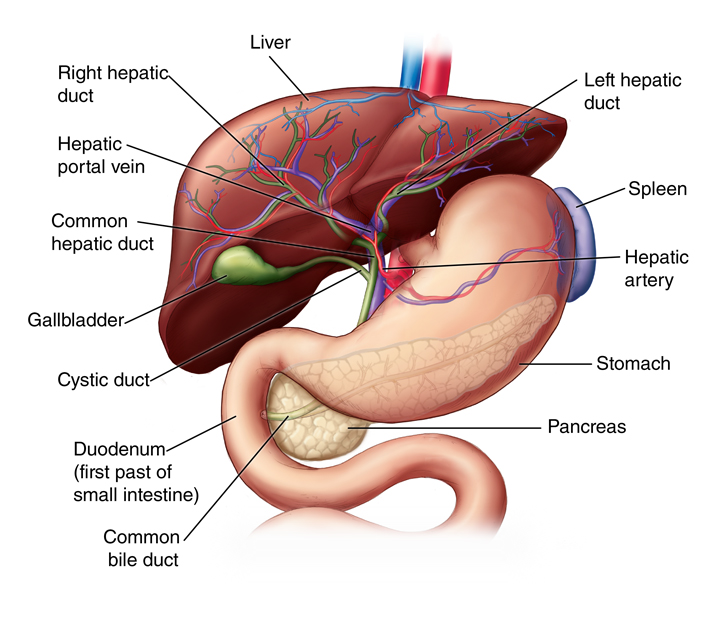
    Liver: Anatomy and Functions | Johns Hopkins Medicine

Photo from: https://www.hopkinsmedicine.org/-/media/images/health/1_-conditions/liver-gallbladder-and-pancreas/liver-anatomy.png 


Liver Lobes

Liver lobes are macroscopic (visible with the naked eye) sections of the liver that can be seen when looking at a liver.  The number and names of the liver lobes is dependent on species.  Some examples are below:

Dogs - 6 lobes

Cats- 6 lobes

Horses - 5 lobes

Cattle - 4 lobes

Whales - 2 lobes

Pigs - 5 lobes

Humans - 4 lobes


Image of a Pig Liver with 5 Liver Lobes:


Anatomic features of pig liver. (a) Pig liver showing relative position...  | Download Scientific Diagram

Photo from:  https://www.researchgate.net/figure/Anatomic-features-of-pig-liver-a-Pig-liver-showing-relative-position-of-each-of-the_fig4_23803968


Liver Lobules

The liver is often discussed in microscopic (cannot be seen with the naked eye) terms as liver lobules.  A liver lobule is a small grouping of liver tissues that make up the functional unit of the liver.  A functional unit of an organ is the smallest categorization of an organ that can perform all of the organ's function.  The liver lobule is the smallest categorization of the liver that can perform every basic function the liver needs to keep an organism healthy. 

💾


There are three (3) major parts of a liver lobule: 


1. Portal Triad (five (5) parts)

    1. Proper hepatic artery (portal arteriole) - Supplies oxygen to the liver, this vessel is an arteriole off the hepatic artery

    2. Hepatic portal vein (portal venule) - High in nutrients and low in oxygen, this vessel is a venule off the portal vein

    3. Bile ductules (bile duct) - Branches of the biliary system, these ducts move bile through the liver

    4. Lymphatic vessels - Vessels which move lymph through the liver (not pictured in image below)

    5. Branch of the vagus nerve - Nerve innervation from the vagus nerve, autonomic nervous system (not pictured in image below)


2. Central vein - Venule that drains deoxygenated hepatic blood into the hepatic vein


3. Hepatocytes - Liver cells


Lobules of liver - Wikipedia

Photo from:  https://upload.wikimedia.org/wikipedia/commons/b/b7/2423_Microscopic_Anatomy_of_Liver.jpg


Portal Vein Anatomy

The portal vein is arguably the most important vessel to understand within the liver because it collects all of the blood that comes from the gastrointestinal system (large intestines, small intestines, stomach, etc.), gallbladder, pancreas, and spleen.  Now, think about what the previous statement means - what does the portal vein carry?

🍛

You guessed it - the portal vein carries EVERYTHING the gastrointestinal tract absorbs and brings it to the liver.  This means the portal vein carries a HUGE amount of nutrients from food, water, microorganisms, toxins, bile salts, etc.  The large amount of microscopic materials present in the portal vein explains the major functions of the liver due to its need to process all of the different contents of the portal vein upon its arrival to the liver.  

🌟

*In a normal, healthy organism, the portal vein will arrive to the liver and the blood will be processed by the liver PRIOR TO returning to the right side of the heart.* (thought provoking question - why is this important?)

🛼

Below is an image that illustrates how all the blood from the gastrointestinal tract flows into the portal vein.  This blood then arrives to and is processed by the liver prior to returning to the heart.


Evolution of the chordates 

Photo from:  https://projects.cos.ncsu.edu/bio370/wrap/TopicsFolder/circulatory3/text_images/portal_vein.jpg 


Now that we understand the basic anatomy of the liver, we will continue to explore the different functions of the liver to allow us to work through some upcoming liver-related cases.  Keep up the great work and catch you all in the next post (which will hopefully happen in a quicker time frame)!


Dr. Haus's Unsolicited Life Advice:  Learn your anatomy - it is the basis of understanding the body


Monday, May 27, 2024

The Liver

 Picture of the Cher Show Broadway Musical prior to the show

Photo by Dr. Haus

The Liver

The liver is an organ that always fascinated me but was never a large focus in any of the courses I taught as there was never enough time.  This bothered me as as the liver affects every other organ in the body and affects the ability of an organism to function and survive.  The liver is an often neglected organ in the study of body systems, especially for undergraduate students.  The liver only took up about one-third of a lecture in my Pathophysiology course though it was not nearly enough time to dive into the amazing world of the liver.  I always dreamed of offering a course that was entirely based on the liver and this is what I am going to try to do here in this blog through this post and many more.

🤓

Liver = Love

A previous student once spoke to me after the liver lecture and mentioned that in their culture the liver is the organ representing love.  They explained to me that you tell someone they are your liver as the strongest way to express your love for another person.  This fascinated me as it was new information and I have an odd interest in the history of language, the root of different words, and understanding other cultures.  As I have read more and more, I see that the liver is used in numerous languages and phrases from African nations to Middle Eastern nations to Eastern nations to express unconditional love and emotion.  

🫶

From a completely scientific standpoint, it makes sense that the liver is associated with love in many cultures as the liver is a vital organ in the body that processes all of the blood flowing throughout the body.  After diving into this information more deeply, I learned most Eastern and Middle Eastern cultures view the liver as the organ of love, not the heart like the Western world.  In the spirit of creating a liver-focused post, I knew I needed to do some digging into the history of the liver in different cultures, and its focus on symbolizing love.

😻

Liver Etymology

Etymology is the study of words, their history, and how words change over time.  This is a great starting point for the word liver because historically it was considered the organ of love, life, emotions, pleasure, and passion.  In Western languages, the liver's historical origins are that it is the organ of emotions, the organ of life, and the organ of courage.  It is interesting that even during ancient times the recognition of the liver's importance for survival was well understood.  To learn more about the etymology of the liver check out the sources links below [1].

🫰

Digging deeper into the history of the liver further increases my fascination with this organ as multiple different ancient cultures viewed the liver as central to the functioning of humans.  Hepatocentrism was the focus of medicine in most ancient populations of humans.  The ancient civilizations in Mesopotamia considered the liver central in the functioning of a human body and the Western world did not move away from this mindset until the 1600s.  The liver was thought to be where a human's soul was housed with some even believing there was a fire (soul) burning in each person's liver [2].

❤️‍🔥

Ancient religious texts, pieces of famous literary works, Greek mythology, and medical writings all focus on the liver being the center of human life in ancient times.  Some of the famous works that demonstrate the reverence felt for the liver are listed below [2]:

  • The Quran
  • Moby Dick
  • The myth of Prometheus
  • The Bible
  • The Tale of Hind bint ‘Utbah
  • Snow White
  • The Torah
  • The God of death in ancient Aztec mythology
  • The myth of Tityus
  • The Iliad
  • Ancient Chinese, Persian, and Urdu medical texts
  • The crucifixion of Jesus Christ

🧑‍🎨

It is interesting to note that the ancient Egyptians did NOT see the liver as the location the soul - the ancient Egyptians saw the heart as the location a soul resides.  This is the reason why the heart was left in a mummified corpse while the liver was not.  The heart remaining in the corpse was thought to allow the person to move into the afterlife to live on forever [2].

🇪🇬

In the 1600s, medical knowledge started to change and scientists of that time discovered that many of the functions they associated with the liver were actually associated with the heart.  It was during this time Western culture started moving away from its reverence for the liver.  There is a work of art in the Museo Storico Nazionale dell'Arte Sanitaria in Rome, Italy called "Il Fegato" that depicts the heart and liver fighting over being the king of organs through the production of blood (interestingly enough, the heart does not produce blood as you all know, but I guess talking about the bone marrow isn't as cute as the heart).  Moral of this story?  I need to get to Rome to check out this painting [2]! 

🇮🇹

Above is a very brief outline of the history of the liver and helps explain common phrases related to the liver in many cultures.  What is most interesting is the strong correlation of the liver and love in most non-Western cultures that seems to have been lost to the Western world in the seventeenth century.  I highly encourage you all to check out the two sources below [1 and 2] as they are good reads and can jump start you on the fun nerd journey of entomology and the intersection of science, medicine, the arts, and language.  To end, I must say, I love my two little livers (my cats).

😎


Liver Education (To be updated as I complete blog posts)


Anatomy

Liver Lobules


Basic Liver Functions

Accessory Organ of Digestion

Organ of Metabolism

Organ of Hematology

Organ of Endocrinology

Organ of Detoxification

Organ of Storage

Organ of Immunity

Organ of Synthesis


Liver Dysfunction

Icterus/Jaundice


 Sources

  1. https://www.ncbi.nlm.nih.gov/pmc/articles/PMC3747976/pdf/nihms493154.pdf
  2. https://www.ncbi.nlm.nih.gov/pmc/articles/PMC6078213/


    Dr. Haus's Unsolicited Life Advice:  Fourth thing you need to know to be a doctor - you need a liver to live


Biking to Cape May - Getting Home

Photo by Dr. Haus The big part of the trip felt done when I arrived in Cape May and I spent four days enjoying Cape May in the off season.  ...